Niche Edits: What They Are, What They Cost, and How to Buy Them Safely

Niche edits are links added to articles that already exist, and are already indexed, on another website. Instead of writing a new guest post, you pay or persuade a site owner to add your link to a relevant older page. They can lift rankings faster than new content, but Google treats paid links that pass ranking credit as link spam, so how you buy them matters.
This guide is for agency owners and in-house marketers deciding whether to buy them. It covers how they work, what Google's policy actually says, published 2026 prices, and the checks I run before and after every placement.
What are niche edits?
A niche edit is a backlink inserted into a published article on a third-party site, usually with a sentence or two of new text around it. The page already has age, indexing history and sometimes traffic, so your link sits inside content Google has already evaluated. Sellers also call them link insertions, curated links or contextual backlinks.
Here is a simple example. A marketing blog has a two-year-old article on project management tools that gets steady search traffic. A SaaS company arranges for its tool to be added to that list with a link, so the link goes live inside existing text rather than on a brand-new page.
The “niche” part matters most. A link from a smaller site in your exact topic may be more relevant than a link from a bigger site that has nothing to do with your business, because the surrounding text gives the link its meaning.
Niche edits vs broken link building and unlinked mentions
Some insertions are earned rather than bought. Broken link building finds a dead link on a relevant page and offers your page as the replacement. Unlinked mention outreach asks a writer who already named your brand to add the link.
All three produce a link inside an existing article, so the result looks the same on the page. The difference is the exchange. Earned insertions give the editor something useful; paid insertions trade money for the link, and that decides how Google's policy applies.
How niche edits work, step by step
The process has five stages: find a relevant page, check its quality, agree the placement with the site owner, insert the link with natural text, then verify it. Marketplaces and agencies may run the first four stages for you. You should always verify the final placement.
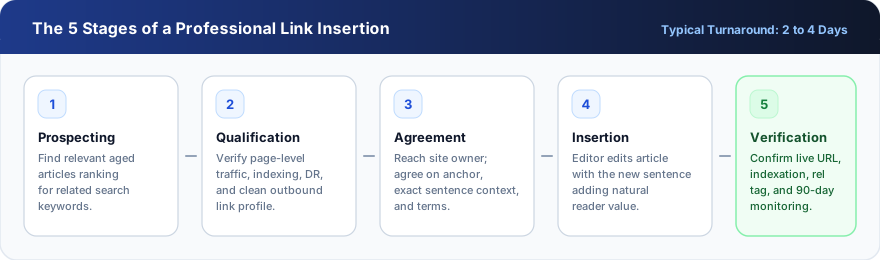
- Prospecting. Find articles that already discuss your topic using Ahrefs Content Explorer, Semrush or Google search operators. One vendor, Editorial.Link, describes filtering for DR30+ sites, pages with real monthly traffic and articles over 1,200 words. These are vendor-specific criteria, not Google's rules.
- Qualification. Check page-level traffic, topical fit and the site's own backlink profile. Use the checklist further down.
- Agreement. Contact the editor or owner and agree on the anchor, the sentence and any fee.
- Insertion. The editor adds the link, ideally with a sentence that gives the reader extra information.
- Verification. Confirm the link is live, crawlable, carries the agreed
relattribute and stays in place.
AA Link Media's turnaround for a link insertion service is typically 2 to 4 business days. Placements are placed directly with verified publishers, but no vendor can guarantee that every placement will be permanently indexed or guarantee specific ranking improvements.
Are niche edits safe?
No paid link is risk-free. Google's spam policies identify exchanging money for links or posts containing links as link spam when the purpose is to manipulate rankings. The policies also address optimized anchor text in articles and guest posts.
Paid links should use appropriate qualifying attributes such as rel="sponsored" or rel="nofollow" when applicable. These attributes tell search engines about the nature of the link. A sponsored link is not intended to pass ranking credit.
Google uses automated systems and, where needed, human review to identify policy violations. Violations can result in links being ignored, ranking changes or manual actions.

| Risk category | Examples | Possible outcome |
|---|---|---|
| Higher risk | Exact-match anchors across many links, unrelated sites, public link-selling patterns and private blog networks | Links may be discounted; a manual action is possible |
| Policy risk remains | Relevant pages and natural anchors, but paid links are still intended to pass ranking credit | Links may be ignored; policy violations remain possible |
| Advertising or earned placements | Earned editorial links or paid links appropriately qualified with rel="sponsored" |
Paid advertising links are not intended to pass ranking credit |
Tell clients this plainly before they buy. If a client cannot accept the policy risk, use appropriately qualified sponsored placements for referral traffic and exposure, and consider earned links and digital PR.
For official guidance, review Google's link spam policies documentation.
Niche edits vs guest posts: which should you buy?
Buy a link insertion when a suitable existing page is available and you want a placement without commissioning a full new article. Buy a guest post when you need more control over the article or no suitable existing page exists.
For a brand-new site, relevant content, earned links and a natural growth strategy may be a better starting point than a sudden batch of paid insertions.
| Factor | Link insertion | Guest post |
|---|---|---|
| Content | A sentence or paragraph added to an existing article | A new article published on the website |
| Page history | Existing page may have indexing history and traffic | New page needs to be crawled and indexed |
| Speed | Can be quicker once the editor agrees | Requires content creation and editorial review |
| Context control | Limited by the existing article | More control over the article's subject and context |
| Main concern | Page changes, removal and paid-link policy risk | Publisher quality and paid-link policy risk |
Both formats can be paid links when money changes hands. If you need complete control over a newly created article, explore our guest post placements.
How much do niche edits cost in 2026?
Pricing depends on publisher quality, niche, available page traffic, geography, editorial requirements and the service model. Publicly listed vendor prices vary from low-cost marketplace placements to several hundred dollars for managed placements.
The following are competitor prices reported in industry research. They are examples of published list prices, not AA Link Media prices and not independently audited averages.
| Provider | Model | Price reported in the research |
|---|---|---|
| INSERT.LINK | Marketplace | From $20 to $30 per link |
| RhinoRank | Managed | From $60; $210 for sites with 1,000+ referring domains |
| FatJoe | Marketplace | $81 at DR10+ to $513 at DR60+ |
| StellarSEO | Managed | $225 flat |
| Reporter Outreach | Managed | $300 to $500 |
| Editorial.Link | Managed | $375 flat |
Industry research also reports the following competitor-sourced ranges by Domain Rating:
| DR range | Reported vendor range |
|---|---|
| DR30–49 | $100–$250 |
| DR50–69 | $250–$450 |
| DR70+ | $500–$800 |
These are published vendor list prices, not audited averages. Domain Rating alone is a poor price guide. Page-level traffic, topical relevance and audience fit matter too.
At AA Link Media, our publisher marketplace displays verified DR, DA, organic traffic, niche and country for each publisher with transparent pricing per placement.
How to vet a placement before you pay
Check the page, not only the domain. A good candidate is an indexed article with relevant content, credible editorial standards and an audience that matches your market.
Ask for the exact URL before payment. If a seller refuses to show the URL, do not order without further checks.

Pre-Purchase Vetting Checklist:
- Indexing: Search the exact URL in Google or check it with an SEO tool. Indexing can change and is not guaranteed.
- Page traffic: Review the page's organic traffic history over approximately 12 months in Ahrefs or Semrush, where data is available. Do not rely on domain-level traffic alone.
- Topical relevance: The article should discuss the same subject or problem that your target page addresses.
- Referring domains: Look for a credible backlink profile rather than a small cluster of sites that all link to each other.
- Outbound links: Check whether the article links to many unrelated commercial sites.
- Authors and editorial standards: Look for credible author profiles, an About page and consistent quality in recent posts.
- Audience fit: The site's readers should match the country, language and audience you want to reach.
What makes editorial backlinks different?
Editorial backlinks are links an editor includes because they help the reader. A useful test is to ask: if the link and its sentence were removed, would the article become less useful?
If not, the link may exist mainly for SEO rather than for readers.
Red flags that mean walk away
- A site openly sells dofollow links without discussing the relevant policy implications.
- Organic traffic is near zero or shows a significant spike followed by a decline.
- High DR but very few relevant ranking keywords.
- Recent articles cover unrelated casino, crypto or CBD subjects on a site with a different editorial focus.
- The seller refuses to share the exact page URL.
- A price seems implausibly low and no meaningful traffic or quality checks are available.
These are warning signs, not proof that a site is a private blog network.
What to check after the link goes live
Verify every placement within a week, then again at 30, 60 and 90 days. Confirm that the link is on the agreed page, uses the agreed anchor and rel attribute, is visible to readers and that the page remains accessible.
- Open the live URL and find the link. Check the anchor text and the surrounding sentence.
- Inspect the link in the page source. Note whether it uses
rel="sponsored",rel="nofollow"or another value, and confirm the implementation matches the agreement. - Check whether the page is indexed and whether it is blocked by
robots.txtor anoindexdirective. - Record the URL, date, price, anchor text and
relvalue in a spreadsheet so the campaign can be audited. - Recheck at 30, 60 and 90 days. If the link disappears within the vendor's written guarantee period, request the promised replacement or refund.
Links can be edited or removed during redesigns, so confirm the replacement window in writing before ordering.
AA Link Media provides live URL and order-status information through our order tracking dashboard, backed by our 100% refund policy if an approved placement cannot be fulfilled.
Keep anchor text natural across the campaign. Avoid repetitive exact-match commercial anchors across multiple placements.
Do niche edits help with AI search?
They may contribute indirectly when a link helps a page become more discoverable or perform better in Search, but a backlink alone does not guarantee visibility in AI-generated answers.
Google's generative AI search features use its core Search systems and may explore related subtopics. Do not claim that niche edits directly guarantee ChatGPT, Gemini, Perplexity or Google AI citations.
For buyers, the practical takeaway is straightforward. An insertion gives you a link, not a brand mention that a journalist chose to write. If AI visibility is a goal, pair a sensible SEO strategy with work that earns genuine brand mentions, such as original research, useful resources and digital PR.
For Google's official advice on appearing in AI search features, see Google's AI features search documentation.
When niche edits are the wrong choice
Skip link insertions when the target page is thin, the website is brand new, the business operates in a high-stakes niche and cannot accept policy risk, or no genuinely relevant existing page is available.
- Thin target page: Improve the content before investing in links.
- Brand-new website: Build a useful content base and pursue relevant earned links rather than relying on a sudden batch of paid insertions.
- Health, finance and legal websites: Assess the business impact of policy violations carefully before choosing a tactic.
- Zero-risk-tolerance clients: Consider appropriately qualified sponsored placements or earned tactics.
- No relevant existing pages: A guest post, resource contribution or original research may be a better fit.
Choosing a link insertion service
Pick a link insertion service that explains its process, gives buyers enough information to assess the publisher, states the link attributes and commercial terms clearly, and reports completed placements.

Five Questions to Ask Any Vendor:
- Will you show me the exact page URL and available organic traffic data before I pay?
- Is the link sponsored, nofollow or otherwise qualified, and will this be stated in the order?
- What happens if the link is removed? Is there a written replacement or refund policy?
- Do you own or control the websites you sell placements on?
- Can I review relevant examples of previous placements?
At AA Link Media, our service focuses on direct publisher outreach, with listings that show metrics such as DR, DA, traffic, niche and country. Buyers can browse available sites and review the information provided before ordering.
If you have weighed the risks and want to proceed, visit our service pages:
Frequently Asked Questions
Are niche edits white hat?
Earned insertions, such as broken-link replacements or links added to an existing brand mention, can be legitimate editorial practices. Paid insertions intended to pass ranking credit violate Google's link spam policies, even when the publisher is otherwise reputable. Paid advertising links should use appropriate qualifying attributes such as rel="sponsored".
Are niche edits hacked links?
No. A legitimate insertion is added by the site's owner or editor with their agreement. Links injected through a security vulnerability are hacked content and are a separate issue. Ask the seller who placed the link and how it was authorized.
What anchor text should I use for a link insertion?
Use descriptive, relevant wording and a natural mix of brand names, URL anchors and other appropriate text. Avoid using exact-match commercial keywords excessively, especially in paid placements. No particular anchor ratio guarantees rankings or policy compliance.
How many link insertions should I buy per month?
There is no universal number. It depends on the website, its content, competition, earned links and the campaign's objectives. Avoid large artificial bursts and focus on relevance, content quality and a sustainable overall SEO strategy.
Can a link insertion be removed after it goes live?
Yes. Site owners can edit or delete a page at any time, including during redesigns or after a site changes ownership. Recheck links at 30, 60 and 90 days, keep a record of every placement and choose a vendor with a clear written replacement or refund policy.
Do niche edits improve Domain Rating?
They may change third-party metrics such as Ahrefs DR because that metric is based on the linking domains and their link graph. DR is not a Google ranking metric, and a higher DR does not guarantee better rankings. Evaluate the actual performance of the target page as well.
About the author
Ahtsham Ali is the founder and operator of AA Link Media, a Pakistan-based link-building marketplace. He works on publisher outreach, order coordination and live URL delivery for customers purchasing placements on international websites.